Innovation Roadmap
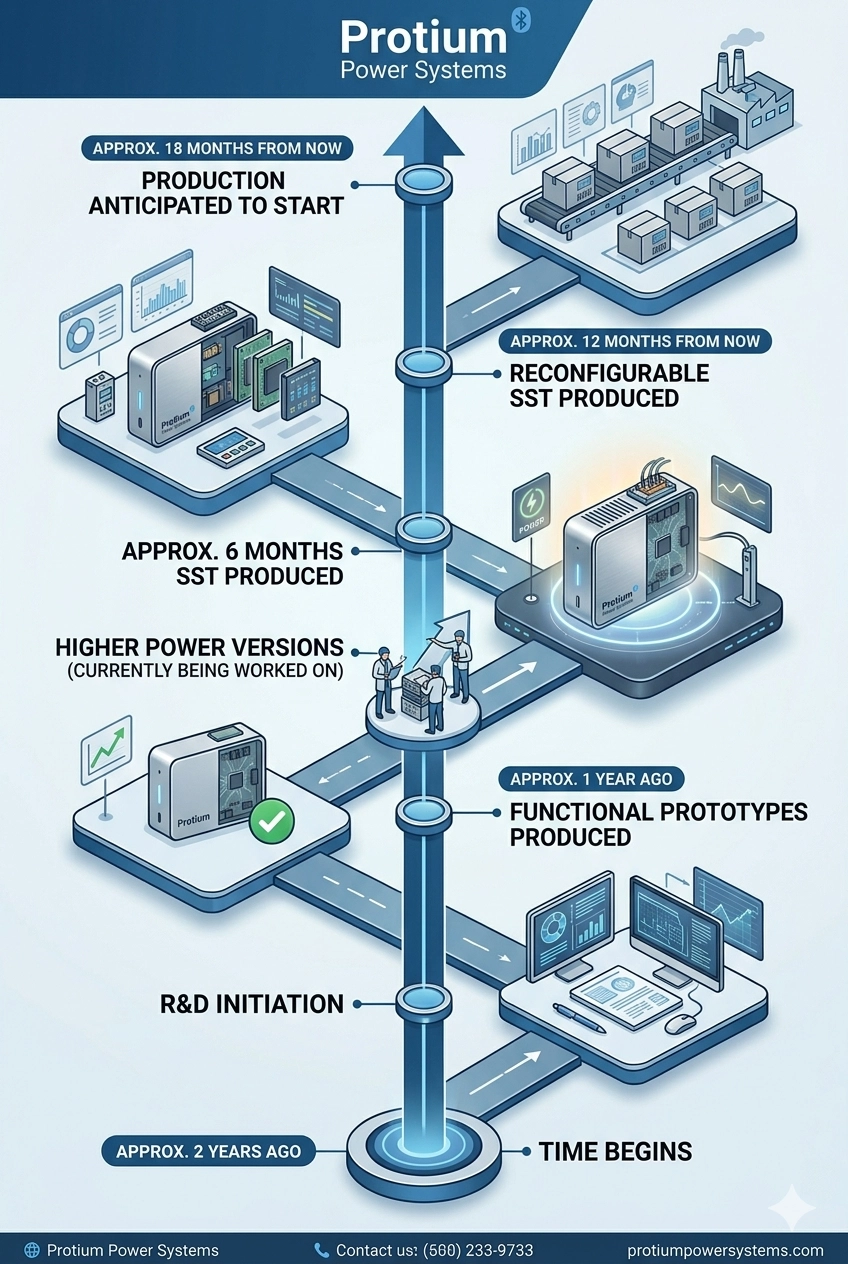
The journey toward a fully solid-state transformer solution began approximately two years ago with the initiation of dedicated Research and Development. This foundational phase focused on the theoretical application of non-magnetic power conversion and the selection of advanced materials to replace traditional iron-core architectures.
By one year ago, the first functional prototypes were successfully produced. These early-stage units served as a proof of concept, validating the core technology's ability to achieve significantly higher power densities in a form factor one-tenth the size of conventional transformers.
Currently, engineering efforts are centered on the development of higher-power versions. This phase involves scaling the architecture to handle higher loads while maintaining the efficiency and thermal stability required for commercial deployment.
In approximately six months, the roadmap anticipates the completion of a working solid-state transformer (SST). This milestone represents the transition from a laboratory prototype to a fully operational system capable of consistent power conversion in a real-world environment.
Following that, in roughly twelve months, a reconfigurable solid-state transformer will be produced. This advanced iteration will feature software-defined parameters, allowing the hardware to adapt to varying power demands and energy inputs without physical modification.
The roadmap culminates in approximately eighteen months with the anticipated start of low-rate initial production. This final stage will mark the availability of Truly Solid State Transformers for integration into commercial power supplies and electronics infrastructure.